WNBA Beginner’s Guide: Everything You Need to Know (2026 Season)
Last updated: May 2026
What is the WNBA?
The Women’s National Basketball Association is the top professional women’s basketball league in the United States. It’s also the most valuable women’s sports league in the world. Founded in 1996, the league is celebrating its 30th season in 2026, with 15 teams across the United States and Canada. After debuting the Golden State Valkyries in 2025 and the Portland Fire and Toronto Tempo in 2026, the league has plans to expand to 18 teams total within the next 4 years, with the additions of Cleveland, Detroit, and Philadelphia in 2028, 2029, and 2030, respectively.
The league is widely considered to be the most elite league in the world. Many WNBA players compete in other leagues globally nearly year-round during the offseason, including EuroLeague Women, China’s WCBA, and others, so every team’s roster contains international experience from players who have been tested in several leagues.
The Global Connection
Rosters in the W pull from every corner of the globe. Players and coaches come from six different continents – places as varied as South Korea, Mali, Hungary, Australia, and Brazil. The WNBA attracts the best women’s basketball players in the world, regardless of passport.
The WNBA is also the primary reason most US fans have entry points into international women’s basketball. The standard for American players has been to go abroad in the offseason, so league favorites like Breanna Stewart, Gabby Williams, and Kahleah Copper have all spent time abroad in the offseason, and excellent players born abroad come to the States and elevate the game here.
Understanding the WNBA is the first step in understanding why the global game is worth following, and where it lives for the rest of the year.
When Is the WNBA Season?
The regular season runs May through September, with playoffs extending into October. Here’s everything you need to plan around it.
- Season dates: May through September
- Regular season length: 44 games per team, 330 total games
- Postseason: September through October
- Finals/Championship: The WNBA playoff format features the top eight teams (regardless of conference) in a three-round postseason. The first round is a best-of-three, Semifinals are best-of-five, and the Finals are a best-of-seven format, with higher seeds hosting one more game than the lower-seeded teams.
The season breaks for All-Star Weekend, as well as for any major international competitions, such as the Olympics. In 2026, the league will break for 17 days (August 31 – September 16) for the FIBA Women’s Basketball World Cup in Berlin, where Team USA will be facing off against other national teams starting on September 4. Games will be available for viewing on TNT, TBS, and truTV, and streaming on HBO Max.
The regular season concludes September 24, followed immediately by the playoffs.
How Does the WNBA Season Work?
The WNBA runs a conference structure of Eastern and Western, with 7 and 8 teams respectively. During the regular season, each team plays three games against every out-of-conference opponent and three to four games against in-conference opponents.
Eastern Conference Teams:
- Atlanta Dream
- Chicago Sky
- Connecticut Sun
- Indiana Fever
- New York Liberty
- Toronto Tempo
- Washington Mystics
Western Conference Teams:
- Dallas Wings
- Golden State Valkyries
- Las Vegas Aces
- Los Angeles Sparks
- Minnesota Lynx
- Phoenix Mercury
- Portland Fire
- Seattle Storm
Standings are determined by win-loss record within their conference, with tiebreakers decided by head-to-head record.
The league’s in-season tournament, the Commissioner’s Cup, runs from June 1-17. Cup games count toward regular season records, but the tournament concludes in a standalone championship game on June 30 between the top teams from each conference based on cup records.
Playoff Structure
The bracket-style postseason features three rounds, beginning with a best-of-three first round featuring the top eight teams, regardless of conference. First round winners advance to the best-of-five Semifinals, followed by the best-of-seven Finals.
Seeding is based on overall record, not conference standing, so the best eight teams make it regardless of conference – this means that a weaker conference wouldn’t automatically send worse teams to the playoffs because of conference placement.
The Finals typically run through October, and at the conclusion, a Finals MVP is crowned from the winning team.
Rules and Format: Things to Note
The WNBA follows the international rulebook closely, so if you’ve watched basketball at any level, most of this will feel familiar, but there are a few things worth knowing before your first game. Here are some of the WNBA rules explained:
Shot clock: 24 seconds, which is the same as FIBA’s. Shorter than the 30-second NCAA clock, the pace is faster than in college. Unlike the MNBA, which resets to 14 seconds after an offensive rebound, the WNBA’s shot clock resets to the full 24 seconds.
Game structure: A game consists of four 10-minute quarters. The game may go into overtime if both teams are tied at the end of four quarters of play.
Foul limits: 6 personal fouls to foul out (same as FIBA, one more than the NCAA’s 5).
Three-point line: The distance is the same as FIBA’s (6.75m / 22.15 feet at the corners), which is slightly shorter than the MNBA line, but longer than the college line.
Roster size: 12 active players per game, with two developmental players that can be activated for a maximum of 12 games each per season.
Overtime Rules: If the game is tied at the end of regulation, the WNBA plays a 5-minute overtime period. If it’s still tied after that, another 5-minute period follows, continuing until someone wins. There is no sudden death tie-breaking format.
Fouls and the Bonus: Each team is allowed 4 team fouls per quarter before entering the bonus – once a team hits 5, every subsequent foul sends the opposing player to the free throw line, regardless of where the foul occurred. Players foul out after 6 personal fouls, one more than in the NCAA, and the same as FIBA.
Replays and Coach’s Challenge: Teams’ coaches have one challenge per game, which must be used immediately after the call in question. If the challenge is successful, the coach keeps their challenge. Reviewable plays include out-of-bounds calls, goaltending, and flagrant fouls – not standard foul calls.
Salary Cap: Every WNBA team works within a salary cap, which is a league-set ceiling on total player compensation per season per team. Unlike the MNBA’s soft cap (which allows for exceptions), the WNBA’s cap is firm. This is negotiated through the Collective Bargaining Agreement between the league and the players’ union (the WNBPA), and is set to increase through 2032.
Supermax Contracts: The supermax is the highest individual salary a WNBA player can earn, and reserved for players who meet specific performance and tenure criteria set by the CBA – All-Star selections, MVP voting, and years of service. As of the 2026 season, the supermax salary is over five times what it was under the previous CBA – like the salary cap, it is projected to increase yearly through 2032.
Developmental Players: Each team can carry two developmental players beyond the standard 12-player active roster. These players can be activated for up to 12 games each per season, which can be useful for teams managing injuries or evaluating newer talent without taking up a full roster spot. Developmental player spots were newly created with the 2026 Collective Bargaining Agreement and do not count against a team’s salary cap.
Draft Rules: The WNBA Draft takes place each spring before the season starts, with 3 rounds, but the pick count per team varies significantly due to the trading of draft picks. The order within each round is determined by the previous season’s team standings in reverse, with the exception of the draft lottery, where the first five picks of round one (the lowest-ranked teams in the league) go through a draft lottery. US college players can enter once they’ve used up their NCAA eligibility, or opt in early if they’re turning 22 that calendar year. International players who haven’t used US collegiate eligibility can enter the WNBA at age 20.
How Much Do WNBA Players Make?
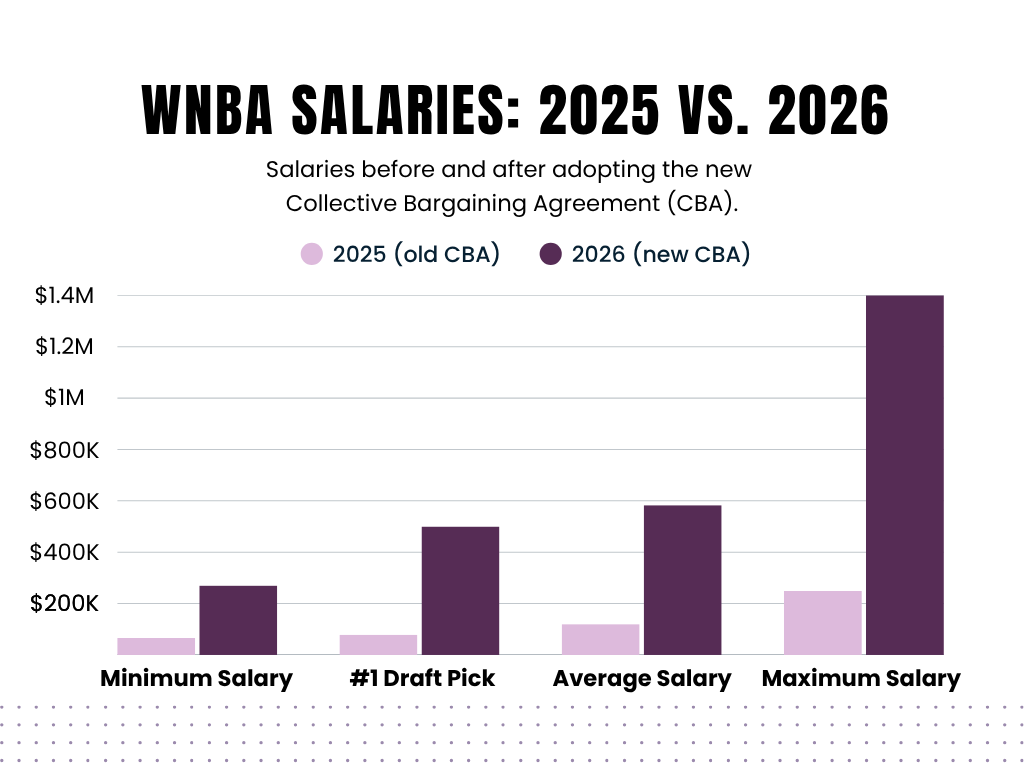
After 8 lengthy days and nights of negotiations and the player’s association voting to authorize a strike if necessary, the league’s Players Association ratified a new 7-year collective bargaining agreement (CBA). While the issues covered in the CBA are numerous, including player housing, pregnancy leave, and payments to retired players, one of the most hotly-debated items was player salaries.
As of the 2026 season, the salary cap increased over 5x from the previous season, now sitting at $7 million, which will adjust each season based on league growth and revenue for the life of the agreement, with exceptions for injured and pregnant players. Minimum salaries start at $270,000, with Azzi Fudd, the #1 2026 draft pick, making $500,000, and the salary range maxes out at $1.4 million – all of which are expected to increase with league revenue to the end of the CBA in 2032.
The Players Association fought hard for this deal, and it may very well result in fewer American players going abroad in the offseason to supplement their American salaries. It will, however, likely significantly increase competition for coveted roster spots, and generate additional interest and competition for international players coming to play in the league – a long-term lucrative contract for both the players and the league.
Teams to Know in the WNBA
Every team in the league has something worth watching, but these are the ones with the most compelling storylines heading into the 2026 season.
- Las Vegas Aces: The reigning national champs, who remain relatively unchanged from the 2025 season (and added Chennedy Carter, who, off the bench, makes a statement about the depth of the Aces roster).
- Atlanta Dream: The Dream finished 2025 with the most wins in the history of the franchise, signed Angel Reese via a trade with the Sky, and kept their core roster (Allisha Gray, Rhyne Howard, Naz Hillmon, Brionna Jones, Jordin Canada, and Te-Hina Paopao) intact. This just might be their season.
- Seattle Storm: This might not be the Storm’s season, but they’re betting more long-term with their recent picks, including Dominique Malonga, Awa Fam, and Flau’jae Johnson. They were hit hard by free agency, so this will be an important rebuilding season for them; this is a good one to watch if you want to see young players whose names will be thrown around in future years.
- Golden State Valkyries: After a freshman season foray into the playoffs, the training wheels are off for this team. The Valkyries will see most of their core return in 2026, and add Gabby Williams, who led the WNBA in steals last year. Their sophomore season is sure to be explosive.
- Chicago Sky: Chicago’s rebuild is somewhat shocking, given the difficulty they went through last year. Skylar Diggins is stepping in to command the floor, Kamilla Cardoso has been steadily improving her game, and Rickea Jackson is a strong forward to pair with a 6’7″ center. The ceiling is unknown, but the floor is higher.
- Dallas Wings: The Wings made some strategic plays in the offseason (including a new coach), and with 2025 Rookie of the Year Paige Bueckers returning and #1 draft pick Azzi Fudd, this team went from last in the standings to a potential playoff contender with one off-season’s worth of moves.
- New York Liberty: The Liberty are thinking long-term – and longer-term than October. They have stars, they have depth, and they have seasoned vets playing alongside talented rookies with a lot to learn. In doing so, they’re setting up the future of the franchise.
Players to Watch in the WNBA
Every roster in the league has someone worth following, but these are the players who will define the 2026 season.
- A’ja Wilson (Las Vegas Aces): A strong contender for the title of Greatest of All Time, with four League MVP wins, three WNBA Championships, and two Finals MVP titles (in 2025, she won all of these in one season, plus Defensive Player of the Year). She’s the face of the Aces, who drafted her first overall from South Carolina 2018.
- Breanna Stewart (New York Liberty): Another in a long line of UConn grads-turned-WNBA legends, Stewie led UConn to four consecutive NCAA National Championships – then won three more in 2018, 2020, and 2024. Add that to the Unrivaled Championship (and MVP) win in 2026, three Olympics gold medals, two EuroLeague titles, and three FIBA World Cup golds – Breanna Stewart wins everywhere she goes.
- Angel Reese (Atlanta Dream): Angel Reese has led the league in rebounding in both her freshman and sophomore seasons, and to date in her career, averages a double-double. She’s joining a roster of players that will complement her style, and the sky’s the limit.
- Paige Bueckers (Dallas Wings): Paige Bueckers won the 2025 Rookie of the Year award with 70 of 72 votes, in part thanks to a single-game rookie points and efficiency record, the first player in WNBA history to score 40 or more points and 80+% from the field. Whether it’s at the Met Gala or on the court, all eyes are on Paige.
- Chelsea Gray (Las Vegas Aces): Known as the Point Gawd for a reason, Chelsea Gray can make points appear out of thin air. She’s been an instrumental part of the Aces championship stories, and won MVP of the 2022 Finals.
- Aliyah Boston (Indiana Fever): Three seasons in, Boston is one of the best interior defenders – a 2023 Rookie of the Year, three-time All-Star, and a player who makes her whole team better.
- Napheesa Collier (Minnesota Lynx): Collier averaged 22.9 points per game in 2025, finished as an All-Star captain by fan vote, was the runner-up for league MVP, is a vice president of the WNBPA, and co-founded Unrivaled – she’s easily one of the best two-way players in the league, and she’s done more for player conditions than almost any other player in history. She’s currently sidelined with an ankle injury, but is expected back sometime in June.
- Marina Mabrey (Toronto Tempo): Marina Mabrey leads every team she’s on – leading Unrivaled in scoring during the 2026 season with 25+ points per game – and just signed a max deal with Toronto to anchor the Tempo’s backcourt.
- Caitlin Clark (Indiana Fever): After missing 31 of 44 of the 2025 season’s games due to a groin injury, Caitlin Clark is hoping to come back better than ever in this season.
- Chennedy Carter (Las Vegas Aces): Chennedy Carter may have been the most talented player that went unsigned in the 2025 season, but she didn’t let that stop her from playing – first in Mexico’s LNBPF for the Adelitas, leading the WBLA in points scored with Al Ula, then finally, averaging 33.1 PPG to lead the WCBA with Shanghai. This year, Aces picked her up hoping to win yet another national championship – and with A’ja Wilson and Chelsea Gray, it looks like a great bet.
- Gabby Williams (Golden State Valkyries): Williams led the WNBA in steals in 2025 with 99 – 30 more than the next closest player, and tied for second-most in a single season in league history – while posting career highs in points, assists, and steals. She’ll be a key player for the Valkyries to build around with her new 3-year contract.
- Brittney Griner (Connecticut Sun): A 10-time All-Star whose story off the court (detained in Russia for 10 months in 2022, and returned in a high-profile prisoner exchange) is inseparable from understanding the story of women’s international play.
- Kahleah Copper (Phoenix Mercury): Kahleah Copper scores everywhere she goes. She’s spent the majority of her career in Chicago – now in Phoenix alongside Alyssa Thomas, Copper has the playmaking infrastructure to reach another level entirely.
- Jonquel Jones (New York Liberty): Jones is a highly-decorated player with a long international resume. She’s played in the WCBA, WKBL, WBSL, Russian League, and plays for the Bosnian National Team, and has signed to play with the upcoming Project B league.
- Arike Ogunbowale (Dallas Wings): Arike is another all-around skilled player, who’s gone abroad several times. After winning the Unrivaled championship with the Mist BC, she went abroad to play with the Sichuan Blue Whales for the WCBA finals, helping them to their third title before coming back to start the season with the Wings. That combined with her recent wedding, and she’s on top of the world.
- Skylar Diggins (Chicago Sky): Diggins is entering her 13th W season across five franchises, still producing at an elite level and now leading a young Sky roster – she’s the kind of veteran presence that will show the younger players how to sustain excellence over a career.
Rising Stars in the WNBA
The 2025 and 2026 draft classes are historically deep. These are the players whose names you’ll want to know before everyone else does.
- Lauren Betts (Washington Mystics): Fresh off a NCAA Championship, Lauren Betts is ready to bring her talents to the W. It’s rare to see a player with the comfort level with explosive movement that she has at that height, but she plays as much like a forward as she does a center.
- Saniya Rivers (Connecticut Sun): Saniya Rivers is the definition of a defensive menace. While she started on the bench for most of the Sun’s season last year, it’s clear she’s going to be a much bigger part of the team’s strategy this season.
- Flau’jae Johnson (Seattle Storm): A rapper and a basketball star, Flau’jae was always part of the Seattle Storm’s plans – but she took a detour. Drafted by the Valkyries first, they traded her to the Storm on draft night for Marta Suarez and a second-round future pick – we think the Storm won that trade, with Flau’jae averaging 16 PPG in the preseason.
- Rori Harmon (Washington Mystics): Taking Texas to the Final Four twice in a row after a twenty-year drought, Rori Harmon was picked in the third round and clawed her way onto the roster after showing impressive chemistry with her teammates and recording multiple steals per game in the preseason. A true floor general, her influence doesn’t always appear in the stats, but she’s calling the plays for her young team with true skill.
- Azzi Fudd (Dallas Wings): The number-one pick and the People’s Princess, Azzi Fudd is an elite shooting guard, winning the 2025 Final Four Most Outstanding Player. She’s especially proficient in threes, averaging 47.4% from the 3-point line in her final college season.
- Kiki Iriafen (Washington Mystics): Kiki Iriafen is one of the most productive frontcourt players in the league – she ranked third in the WNBA in total rebounds in 2025 with 376 – and her chemistry with fellow Mystic Sonia Citron is undeniable.
- Kaitlyn Chen (Golden State Valkyries): First the Valkyries drafted Chen out of UConn, then waived and subsequently re-signed her, then relegated her to a training camp contract – through it all, Kaitlyn Chen kept her head down and worked on her game, playing in Athletes Unlimited and EuroLeague. The team signed her to a full-season contract for 2026, and it’s clear her offseason time was well-spent.
- Sonia Citron (Washington Mystics): Citron was the third overall pick in the 2025 draft, and an efficient one – she ranked first in the W in 3-point efficiency during her rookie season. Sonia loves threes (just ask Kiki Iriafen).
- Aziaha James (Dallas Wings): A 2025 second-round pick who made the Wings’ roster and held on despite limited minutes last year, James is an athletic wing with both size and three-point range. She’s clearly developing her offensive game alongside Bueckers.
- Raven Johnson (Indiana Fever): Raven and former South Carolina teammate Aliyah Boston reunite in Indiana, where the Fever would do well to utilize her talents on both ends of the floor this season.
- Olivia Miles (Minnesota Lynx): A Notre Dame and TCU guard and #2 pick in the 2026 draft, Miles averaged 6.5 assists per game in her senior year and has the playmaking ability to eventually run a team – her development under Cheryl Reeve may be similar to that of a rookie Napheesa Collier.
- Te-Hina Paopao (Atlanta Dream): Paopao is a second-year guard who showed three-point range and offensive creativity in limited minutes with Atlanta last year – she’ll fit well with Angel Reese on the Dream’s roster this year.
International Players in the WNBA
The WNBA draws the best players in the world, and because there’s no foreign import limit like there is in many other leagues, such as Turkey’s KBSL and China’s WCBA. This is one of the things that differentiates the WNBA from other major US sports leagues – players are stars in their home countries and national team mainstays. Coming to the WNBA is often the final frontier for international players.
- Han Xu (New York Liberty): At 6’11”, Han Xu is the tallest active player in the WNBA. This isn’t her first time playing for the New York Liberty—she was cut from the team in 2023 and has returned for the 2026 season. Her footwork is impressive for a player of her size, and she seems much more comfortable on the court in the early stages of this season than in previous years.
- Dominique Malonga (Seattle Storm): Dominique Malonga is stunning on the court, and she’s just getting started. While Unrivaled was her first foray into 3×3, she seized the opportunity, and her game grew considerably during her season with the Breeze BC (including the season’s only dunks).
- Marine Johannés (New York Liberty): Known as the Wizard, and pioneer of the Eurostep, Johannés has been a key piece of the Liberty’s offense for a few years now. She plays with a French flair that makes her fun to watch even when she’s not scoring. She’s been to three Olympics, spent years sharpening her game at the highest level in Europe and Turkey, and brings a creativity to the Liberty’s backcourt that no other player on the roster replicates.
- Alanna Smith (Dallas Wings): A’ja Wilson isn’t a bad player to share an accolade with – she and Alanna Smith were named Co-Defensive Player of the Year by the W in 2025, with 80 total blocks in the season. During 2026 free agency, she signed a multi-year deal with the Dallas Wings, so she’s a key piece of the team’s future plans.
- Julie Allemand (Toronto Tempo): Allemand helped lead Belgium to back-to-back EuroBasket Women’s titles and arrives in Toronto as one of the most decorated point guards in European basketball – a pass-first guard whose court vision and pace control give the Tempo a floor general.
- Dorka Juhász (Minnesota Lynx): 26-year-old Juhász sat out the 2025 WNBA season to rest after playing year-round through EuroLeague competition at Schio, and returns to Minnesota in 2026 having refined her game against the best competition in Europe – a product of UConn with Hungarian national team pedigree.
- Jihyun Park (Los Angeles Sparks): Number one draft pick in the WKBL in 2018 and a competitor on the Korean National Team, this is Jihyun Park’s first year in the WNBA. As a forward-heavy team, she may be a backup for a backup, but she may just have the chance to prove herself on an international stage with the Sparks.
- Kamilla Cardoso (Chicago Sky): Winning two national championships with South Carolina before entering the WNBA, Cardoso has put in serious developmental work in the WCBA and enters 2026 paired with Rickea Jackson in Chicago – if the chemistry is there, the Sky will have a dynamic duo.
- Ezi Magbegor (Seattle Storm): Magbegor is one of the best defensive bigs in the WNBA – an Australian national team member who ranked in the top 10 in blocks per game multiple times, she anchors Seattle’s interior.
- Li Yueru (Dallas Wings): After winning the Unrivaled championship with WNBA teammate Arike Ogunbowale, she has serious W legitimacy without even considering her as one of China’s most prominent national team players.
- Georgia Amoore (Washington Mystics): Amoore, an Australian player, missed her entire first season with the Mystics due to a torn ACL, but she’s returning with a vengeance to take the starting point guard position, which should give Sonia Citron the ability to play the role of shooting guard more comfortably.
- Leonie Fiebich (New York Liberty): You wouldn’t know Leonie Fiebich is only 26 if you saw her accomplishments. Fiebich won a championship with the Liberty in her first year, and is set to be a mainstay on their roster. She’s a German national team standout who gets regular minutes on a stacked team.
- Luisa Geiselsöder (Portland Fire): Geiselsöder signed to Dallas from Germany in 2025, then was selected by the Fire in the 2026 expansion draft. She’s a strong rebounder, and if she can develop her assists game, she could be a great backcourt director.
- Awa Fam (Seattle Storm): Born in Alicante to Senegalese parents, Fam,a 6’4″ center, has started early. She signed her first professional contract at 15, played EuroLeague as a teenager, and arrived in Seattle as one of the most anticipated international picks in years. The Storm selected her third in this year’s draft and are building their future on her timeline.
- Sika Koné (Atlanta Dream): Mali is a growing force in African basketball, and Koné is part of the reason why. She plays on the Malian team, and has previously had limited appearances on the Sky, Liberty, and Mystics. As a forward in AfroBasket, she’s been a skilled rebounder, and we’re hoping to see this continue on the Dream.
- Justė Jocytė (Golden State Valkyries): Jocytė was the highest-drafted Lithuanian player in WNBA history and one of the most decorated young players in European basketball before coming stateside; her first WNBA minutes will be closely watched by everyone who has tracked her internationally.
- Bec Allen (New York Liberty): Allen has played professionally in Australia, Spain, France, Poland, and the US across her career, competing for Fenerbahçe with teammate Breanna Stewart in EuroLeague most recently before returning to the Liberty – the franchise where her WNBA career began in 2015. A 2021 Olympian with her native Australia, she brings a decade of international experience to New York’s rotation.
- Damiris Dantas (Indiana Fever): Dantas has played for the Lynx dynasty, the Dream, and now the Indiana Fever. She’s a Brazilian national team member and 11-year W veteran who brings shooting range from the forward position and a championship mindset to a Fever team looking to make it further than the semifinals this year.
- Stephanie Talbot (Las Vegas Aces): Talbot is a three-time Olympian and 2024 Olympic bronze medalist with the Australian national team who brings multi-position defensive versatility and three-point shooting to the Aces’ depth — a career WNBL MVP who has played in the US, Europe, and internationally across a professional career that spans 15 years.
- Awak Kuier (Dallas Wings): Kuier was the No. 2 overall pick in 2021 and spent a few years developing in EuroLeague before returning to the WNBA with Dallas in 2026 – a Finnish-South Sudanese forward with elite length and a passing ability unusual for her size, returning to the Wings this season with significantly more experience.
- Pauline Astier (New York Liberty): A brand new player to the WNBA, 24-year-old Astier brings with her playing experience alongside Bridget Carleton and Janelle Salaün with USK Praha in EuroLeague. She was a silver medalist with the French national team in 2024 against many of the same players she’s now playing alongside on the Liberty.
- Laeticia Amihere (Golden State Valkyries): Amihere is a Cameroonian-Canadian forward who has represented Canada internationally and improved in each of her three WNBA seasons. She’s a safe, solid pick for a team of playoff hopefuls.
How to Watch the WNBA in 2026
Games are spread across several platforms this season. Here’s where to find them and what each option costs.
- WNBA League Pass (out-of-market regular season games, on-demand replays of all games): $39.99/year, $14.99/month. Student discounts available for undergraduate and graduate students in Australia, Canada, Ireland, New Zealand, the UK, and the United States. Also available via Amazon Prime.
- Amazon Prime (30 regular-season games, Commissioner’s Cup Championship, and one first-round playoff series): Amazon Prime, $139/year or $14.99/month, Prime Student, $69/year or $7.49/month, Prime Access, $6.99/month for qualifying government aid recipients, Prime Video, $8.99/month.
- Live broadcast games: Games are intermittently available on ABC, ESPN, ESPN2, CBS, CBS Sports Network, NBATV, NBC, and USA Network. Check local schedules for more information.
- Peacock (26 regular-season games, semifinals, and finals): Peacock Premium, $10.99/month or $109.99/year. Eligible students can get Peacock for $5.99/month.
- International viewers: WNBA League Pass is available everywhere except Belarus, China, Cuba, Iran, North Korea, Russia, Sudan, and Syria.
- Free options: All ION games can be viewed on Tubi with ads. All locally broadcast Atlanta Dream games are available on Victory+.
Where to Start
If you want one game to orient yourself before the season gets going, find a Liberty-Aces matchup from the 2024 playoffs. Two of the best-constructed rosters in recent memory, the highest possible stakes, and a clear picture of excellence in the league. Start there, then get League Pass, or find free games on Tubi if you want to watch before committing.
For current standings, results, and analysis, follow WBB.global on X, Instagram, Threads, or TikTok.
One Number to Know
Over 20% of WNBA players come from outside the United States, and even more than that have played abroad in the offseason and for development. In many major US sports leagues, international players are the exception, but in the WNBA, they’re woven into the fabric of the league.
Conclusion:
Early detractors said it couldn’t be done, that it wouldn’t make money, that no one would watch a women’s basketball league, and the WNBA has been proving them wrong for the last thirty years. The quality of the game is only growing, just like the viewership. The league is just getting started.
This guide is updated each season. For current standings, results, and analysis, browse our WNBA coverage.
Subscribe to our newsletter to stay in-the-know on all things women’s basketball.
 WBB.global